Choosing The Right School for Your Children
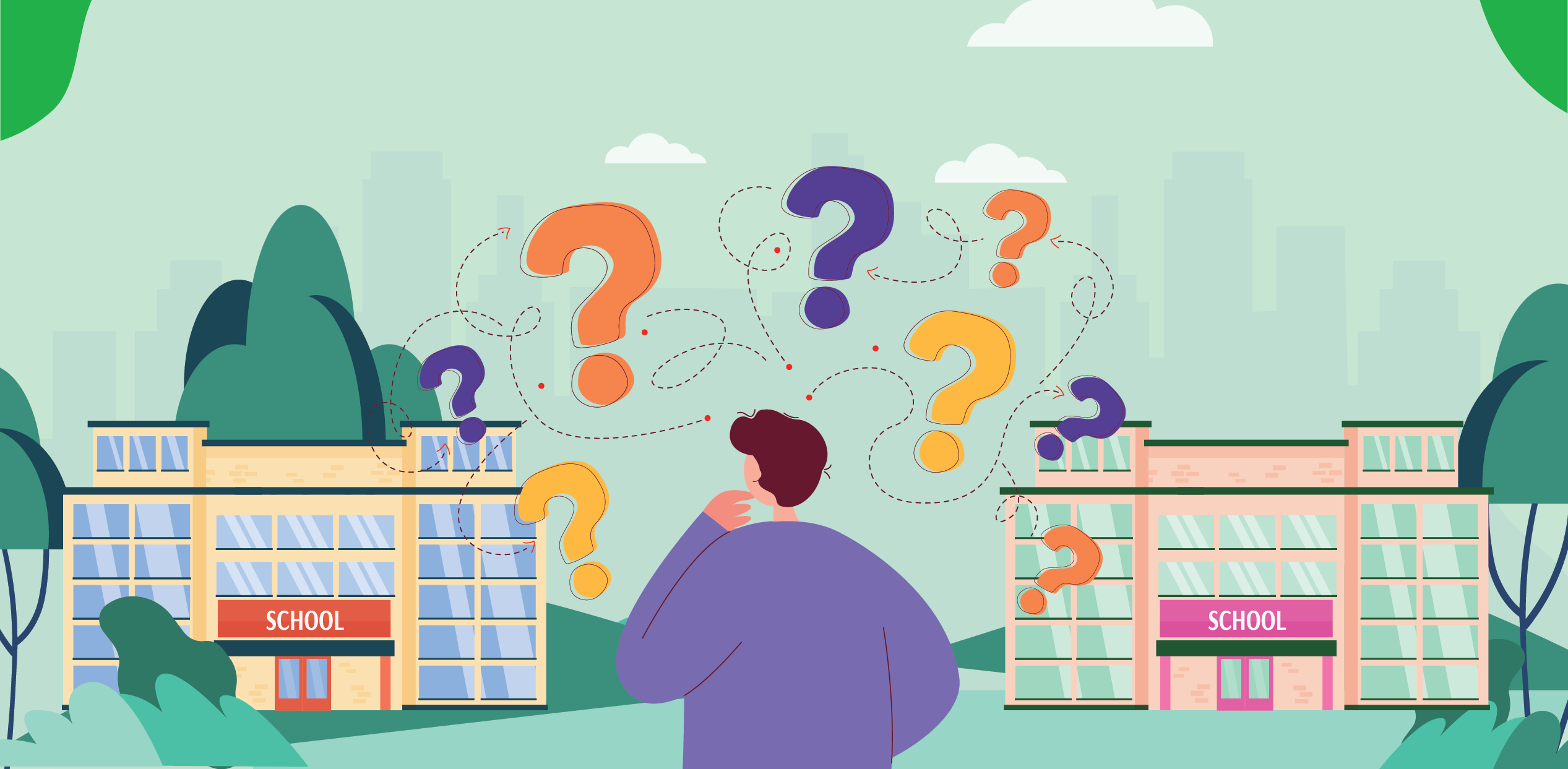
It’s hard to pick a school for your children, huh?
Choosing where your children would spend a good chunk of their days to receive formal education is one of the most challenging milestones in the lives of parents and guardians. So many things to consider. So little time – your children are growing up as you’re reading this.
Parents in the olden days seemed to have less of a stress when it came to picking schools for their kids. They tended to just haul their children to whichever schools were nearest that are within budget, and they were inclined to almost blindly trust the teachers that they would do the job well. The curriculums that were in place and how they were taught were pretty much standardized. Students in those days were expected to just flourish under a uniform system, and when they couldn’t keep up academically, the blame was almost always put on them – they didn’t study hard enough, they played too much, or worse:
They were resigned to the belief that they were just plain stupid.
Yeah, no.
The current science understands that children came in all sizes and forms, and that variety includes needs that are unique. Some children are just born with the dispositions that are meant for the standardized curriculum while some others are not.
The famous quote “Everyone is a genius. But if you judge a fish by its ability to climb a tree, it will live its whole life believing that it is stupid.” is often misattributed to Albert Einstein (source is unclear), but that error does not diminish the validity of the quote – you can’t view children as monolithic beings.
Your children are unique and all of them need schools that would bring the best out of them that would cater to their specific needs. This is why picking the right school for your children is important, and having the right set of information is half the battle.
Let’s get into the factors to consider when you’re trying to choose which school is best for your children!
Types of Schools
Just as there are many kinds of children, each with distinct needs and interests, schools also come in a variety of types. The types of schools available are also dependent on where you are living or planning to enrol your children. A few examples will be given as follows:
Public Schools
Depending on where you are located, public schools can also be known as state schools or government schools. Public schools are either wholly funded or partly funded by the local government using taxpayers’ money allocated for education purposes.
A typical public school has a large classroom size – often accommodating more than 20 pupils at a time with schedules that are usually rigid and uniform across the state or country. Public schools are regulated and controlled directly by education departments of each country’s ministry of education or its equivalents.
Public schools either charge parents or guardians relatively affordable tuition fees or are entirely free. Public schools in some countries also provide meals and lunches for a very low cost or for free. In a lot of countries, admission to this type of school usually is contingent on your address of residency – meaning that your children can only enrol on schools that are within relative proximity to your home.
Public schools typically serve pre-kindergarten to secondary/high school-aged children.
If your children are enrolled in a public school, you can expect your children to study the curriculums that have been designed by the state’s education department, be exposed to a large number of students that come from various socio-economic backgrounds, and pay very little or nothing for their education.
Private Schools
Private or independent schools (interchangeable depending on countries) are typically funded through the tuition fees they charge the parents or guardians, or are partly funded by the organization that they are tied to. In general, private schools do not receive funding from the state government so they could cost you some pretty penny if you decide to enrol your children in this type of school.
How private schools are run differs from country to country. In some countries, the curriculums that are being taught in private schools still generally adhere to their respective state education department with some liberty to add and modify the structure. In some other, private schools are almost wholly independent, meaning that these schools are in charge of their own governance, finances, and curriculums.
Religious schools (Catholic schools, Madrasahs, etc) typically fall under the umbrella of private schools in some jurisdictions. Some religious states can have religious schools as their public schools.
Charter Schools
Charter schools are, in essence, a marriage between public schools and private schools, in which they receive public funding but are governed privately.
Charter schools enjoy the autonomy of governance and are much more flexible in designing their curriculums and school hours, but they have to be accountable for the performance and welfare of the students under their care.
In short, they still have to answer to the government if and when their student’s well-being and academic needs are not being met according to each country’s respective accountability standards.
Curriculum
People often measure the excellence of a school by the kind of curriculum it offers. It makes sense because a curriculum dictates students’ experience throughout their academic life. As parents, it is your duty to understand your children’s individual needs and interests, and factor them into which schools would they fit best.
The following are 2 curriculums that are globally reputable with more and more schools adopting them wholly or imparting aspects of them into their standard curriculums:
Cambridge Assessment International Education
Designed and formulated by the University of Cambridge in the United Kingdom, this is one of the foremost curriculums and is recognized by many countries. The Cambridge curriculum is well-established with the reputation of holistically educating students in 4 fields – Science, Mathematics, Humanities, and Languages. Around 10,000 schools globally have adopted the Cambridge way of educating students.
This curriculum trains students in disciplines such as critical thinking, effective research, and analytical skills. The Cambridge qualification (A-Level) is suitable for students who know what they want to do in their further academic studies, and they have a degree of liberty to pick and choose the subjects they study that would best fit their aptitudes and interests.
Students educated in the Cambridge curriculum will have a competitive advantage that will set them apart from their peers who are studying under less globally-recognized curriculums.
International Baccalaureate (IB)
This education framework was developed in Switzerland and is currently being offered in 4,500+ schools across the globe. Students under the IB program have more freedom to curate their own learning experience compared to its Cambridge equivalent.
Aside from the regular academic subjects, students are also encouraged to be independent thinkers by way of having them take on projects of their choosing while being guided by the teachers
The IB qualification is recognized worldwide, thus, students with an IB diploma tend to fare very well in a global setting.
STEM-focused education framework deserves an honourable mention as it is progressive, time-relevant, and is much needed in an increasingly digital world. Many schools in a lot of countries are starting to impart STEM education methodologies in their science and mathematics classrooms, so you may want to include this when doing your due diligence as parents or guardians.
Lastly, parents also need to consider the diversity of co-curricular/extra-curricular activities that are being offered by the school. The availability of diverse extra-curricular activities enriches the learning experience and bolsters your children’s education holistically. Look for schools that offer STEM, sports, and art-related activities to engage your children after school.
Classroom Size & Population Diversity
These two factors affect the effectiveness of students’ learning. Educators and academic institutions worldwide are becoming increasingly aware of the positive impacts that can be created by prioritizing them in schools.
Classroom Size Matters
A study that was done in the late 1980s on Class-Size Reduction (CSR) in Tennessee under the name of Student Teacher Achievement Ratio (STAR) showed a direct correlation between smaller class sizes and students’ academic performance.
This study compared the effectiveness of learning between two classes of differing student densities. One class was filled with just 15 students, while the other class was populated by 22 students, with teachers randomly assigned between the two classes. The result of the study revealed that the classroom with fewer students performed comparatively better than the classroom with more students. Quantitatively, the smaller classroom performance was on par with students who had received an extra three months of schooling.
This result makes sense as a smaller classroom size means that teachers and facilitators have more time to focus on each student during a classroom period. A smaller population can also mean that there’s less distraction when class is in session
Population Diversity
As the world’s population is becoming more interconnected with the advent of digitization, children are being exposed to cultural identities and features that are diverse and different from themselves. Diversity does not only include race, skin colour, and ethnicity, but also religions, socio-economic standing, and mother tongues.
Students that feel represented by their peers and the teaching staff may feel a sense of belonging in that school. That feeling of being able to relate between teachers and students may create a savoury experience for learners, which would incentivize students to want to be in school and ultimately gain a valuable education.
Teaching Staff & School Facilities
The way the school is set up, the quality of teachers that are hired, and the facilities to accommodate a conducive learning experience are important factors to consider when choosing a school for your children.
Qualified Teachers
A quality teacher is someone who is patient, kind, knowledgeable, and an excellent communicator, which are qualities that you hope will be passed down to your children. Remember, during these formative years in school, your children’s brains behave like a “sponge”, in which they absorb a lot of information and stimulus that they’re exposed to.
As parents and guardians, it is incumbent on you to visit your children’s prospective schools, meet with the principals and teaching staff, and ask a lot of questions.
What kind of formal qualifications do the teachers have? How do they resolve conflicts between students? What is the best way to communicate with the teachers? How do they teach the subjects?
A good teacher should show enthusiasm and a love for teaching. They should also be able to appease the worries that you as parents might have. Again, communicate your questions, and ask a lot of them.
Last but not least, look for schools that are staffed with teachers that are trained to perform first-aid procedures such as Cardiopulmonary Resuscitation and abdominal thrusts (Heimlich Maneuver), and are equipped with the knowledge to deal with common allergy triggers and symptoms.
School Facilities
Depending on where you live and your socio-economic background, concerns over school facilities may vary.
Those of you who live in tropical countries may be able to get by comfortably with classroom fans, but for students in countries that experience winter, working heaters are a necessity.
Also, with the burgeoning need for being digitized, schools nowadays need to be able to accommodate IT education. Up-to-date computers, WiFi connections, and tablets may be considered basic needs as they are able to better facilitate learning in general. Digitization has also made remote learning possible and necessary in some cases, so the school would need to cater to this specific way of learning.
It is also important to consider, especially for parents and guardians with children who have special needs and disabilities, to choose schools with infrastructures that are able to accommodate their specific conditions. Ramps, bannisters, Braille writing systems in strategic locations, and general accessibility are getting more and more normalized as a part of a school’s basic infrastructure.
Wealthier private schools that charge premium tuition fees tend to come with premium facilities such as air-conditioned or heated classrooms. They may also be equipped with state-of-the-art gymnasiums, swimming pools, running tracks, and multi-purpose courts just to name a few.
It is nice to have your children studying in a school that is able to cater to each student’s unique and often changing needs, but don’t break your bank and compromise the quality of life of your family. Remember, as long as your children’s basic physiological and psychological needs are fulfilled, they can thrive in a decent school.
Budget
The budgetary concern is one of the major factors that affect parents’ and guardians’ decision making.
As mentioned previously, public schools are typically the less expensive (or free) option whereas private schools cost money – often very expensive, charging upwards of USD 150,000+ (Collège Alpin Beau Soleil, Switzerland) for their annual tuition fee.
Sound financial planning on the parent’s or guardians’ part is therefore imperative if one chooses to enrol their children on a private school because, for some families, the tuition fee alone would make up a considerable chunk of the household’s overhead.
Parents and guardians may want to set up a special fund either in the form of savings or insurance/investments. Your fund in savings typically will not beget you as much growth compared to education insurance schemes. Education insurance, however, is a much riskier path as the funds will be managed as an investment by the bodies you choose to purchase the policies from.
Whatever you choose to do when it comes to funding your children’s education though, it is best that it does not burden the household too much that it compromises the family’s comfort at home. Remember, your children would typically spend more time at home than they do at school, so observance of your children and other members of the family’s basic needs (sustenance, clothing, and shelter) should be your top priority.
Location
Where your children’s future school is located is a major consideration factor. Location affects commute time, accessibility, and overall comfort for your children. Your area of residence is sometimes a factor that affects enrolment in public schools per some countries’ regulations. Private and charter schools are generally able to accept students regardless of their zip codes.
If you have a personal vehicle, then the location of your children’s school may not be as crucial a factor. If you don’t, however, then your children’s school need to be accessible by public transport, located in a safe neighbourhood, and preferably within proximity to public health facilities, law enforcement, and fire stations.
Conclusion
There are many factors to consider when you want to choose a school for your children and they can be overwhelming. You may take your time to understand how each factor ranks on your priority list, but do make your children’s needs, interests, and aptitudes the highest on that list.