Jan 14, 2026

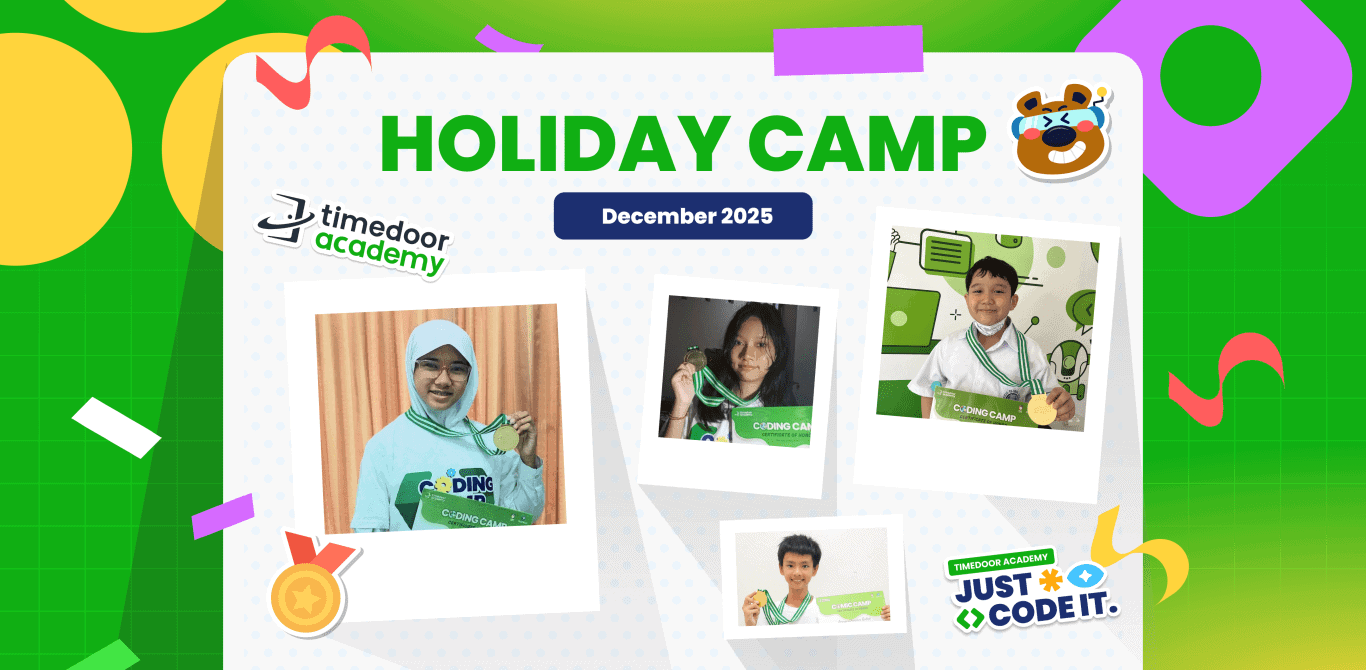
Official Announcement of Holiday Camp Awards December 2025

Official Announcement of Holiday Camp Awards December 2025 image

We are thrilled to celebrate the success of Holiday Camp 2025 held by Timedoor Academy, which took place from December 15 to December 30. This year’s event was our biggest yet, welcoming over 500 talented students from across Indonesia!

The experience reached new heights this year with the debut of our latest “Programs such as Cyber Heroes, in which students identify cyber threats such as phishing and malware by using Mini Games & Scratch, and also Make AI with Pictoblox, providing a well-rounded and immersive learning environment. On this special occasion, the students dived deep into their passions—ranging from Python and Roblox Development to Artificial Intelligence, and Comic Making.

Under the mentorship of our expert teachers, participants tackled ambitious projects and sharpened the digital skills essential for their futures. After much deliberation, we are now ready to honor those who truly stood out for their creativity and dedication.

We are proud to present the winners of the Best Project and Best Participant awards:

JUNIOR ANIMATOR
CATEGORY PARTICIPANT’S NAME BRANCH
Best Project Rayson Devatta Wang Jambi
Best Participant Rafka Irtiza Syaqier Sentul
JUNIOR 3D GAME
CATEGORY PARTICIPANT’S NAME BRANCH
Best Project Mikael Jose Alvaro Cikarang
Best Participant Kyrie Manado
JUNIOR CONSTRUCT
CATEGORY PARTICIPANT’S NAME BRANCH
Best Project Justin Owen Tandi Cikarang
Best Participant Saddam Khairul Hanif Cikarang
AI WITH PICTOBLOX
CATEGORY PARTICIPANT’S NAME BRANCH
Best Project Alden Immanuel Barneth Bandaso Mandagi Cikarang
Best Participant Raizel Zane Wiltan Palembang
CYBER HEROES
CATEGORY PARTICIPANT’S NAME BRANCH
Best Project Thomas Harvianz Green Lake City
Best Participant Fransisca Karla Alveenia Hadiwijaya Yogyakarta
KIDS CONSTRUCT
CATEGORY PARTICIPANT’S NAME BRANCH
Best Participant Zara Shaquitta Tanujaya BSD
KIDS ROBLOX
CATEGORY PARTICIPANT’S NAME BRANCH
Best Project Habibi Rafif Cibubur
Best Participant Ziggy Raziq Rizalya Makassar
KIDS PYTHON
CATEGORY PARTICIPANT’S NAME BRANCH
Best Project Bennedict Javier Jambi
Best Participant Felix Gerard Wyenn Tanjung Duren
TEENS WEB DEVELOPER
CATEGORY PARTICIPANT’S NAME BRANCH
Best Project Nathanael Andromeda Juan Kristanes Batam
Best Participant Muhammad Hafizh Prananda Aryawan Malang
TEENS ROBLOX
CATEGORY PARTICIPANT’S NAME BRANCH
Best Project Marcia Josephine Renon
Best Participant Muhammad Fajri Akbar Lampung
TEENS PYTHON
CATEGORY PARTICIPANT’S NAME BRANCH
Best Project Rayhan Avicenna Alfatih Jagakarsa
Best Participant Kalyana Adinda Parahita Jagakarsa
TEENS AI
CATEGORY PARTICIPANT’S NAME BRANCH
Best Project Tsaqif Bariq R.H. Gayungan
Best Participant Elishine Syallom Citraland
 COMIC KIDS
CATEGORY PARTICIPANT’S NAME BRANCH
Best Project Katrina Amadea Tanuwidjaja Online
Best Participant Flynn Oliseh Opene Online
IOT KIDS & TEEN
CATEGORY PARTICIPANT’S NAME BRANCH
Best Project Daffa Muhammad Zahir Cikarang
Best Participant Gerald Kelapa Gading


Keep Reading

Fun Science Experiments For Kids You Can Try at Home in 2025
Children are naturally curious. Unfortunately, that curiosity can fade when learning feels limited to books or school assignments. In reality, learning can be a fun activity you enjoy together at home. One of the best ways to keep your child engaged is through fun science experiments for kids. These experiments are not just for fun. They are also a simple and effective way to introduce basic concepts of logic, cause and effect, and help children develop structured thinking. Plus, they offer valuable quality time for parents and children to bond. Why Should You Try Science Experiments at Home? Before we dive into the examples, it is worth understanding why fun science experiments for kids are so beneficial. First, kids learn better when they can see and experience things directly, rather than just reading about them. Second, it shows children that learning is not always about sitting still at a desk. Third, it creates opportunities for meaningful parent-child interaction through shared learning moments. Simple and Fun Science Experiments For Kids No need for complicated tools. Most of these activities use everyday items you probably already have at home. 1. Baking Soda and Vinegar Volcano A timeless experiment that never fails to impress. Build a small “volcano” from clay or playdough around a container, add baking soda, then pour vinegar mixed with food coloring. The result is a small lava-like eruption that kids will love. 2. Walking Water Rainbow Line up cups filled with colored water, placing empty cups in between. Connect them with folded paper towels. Over time, the water will "walk" through the towels and mix colors, creating a rainbow effect. This is a fantastic visual example of capillary action and a perfect fun science experiment for kids. 3. DIY Lava Lamp Using a plastic bottle, add vegetable oil, water, food coloring, and an effervescent tablet. Watch as colorful bubbles rise and fall, mimicking a lava lamp. This teaches kids about density and simple chemical reactions. 4. Magic Milk Pour milk into a shallow dish, add drops of food coloring, then touch the surface with a cotton swab dipped in dish soap. The colors will swirl and move due to changes in surface tension. This fun experiment also sparks curiosity about how molecules interact. 5. Static Electricity Butterfly Cut a butterfly shape from tissue paper, rub a balloon on your hair, then bring it close to the paper. The butterfly wings will "lift" due to static electricity. This simple and entertaining activity helps children understand basic physics concepts. From Science to Coding: Training a Child’s Logical Thinking At first glance, these fun science experiments for kids might seem simple. However, they actually help develop logical thinking, patience, and step-by-step problem-solving. These are the same foundational skills used in coding. Coding teaches children to break down complex problems into smaller tasks, much like the scientific process in experiments. Both require focus, precision, and persistence. If children become familiar with structured thinking through simple science activities, transitioning to coding will feel like a natural and enjoyable next step. Tips to Keep Home Experiments Fun and Stress-Free To make sure your experiments go smoothly and your child stays excited, keep these tips in mind: Safety first. Always supervise, even when using everyday materials. Get your child involved from the start. Let them help prepare and take ownership. Do not fear failure. Mistakes are valuable learning opportunities. Relate experiments to everyday life. Show how science is all around them. Learning Can Be Fun and Practical By doing fun science experiments for kids, parents can make learning more enjoyable and hands-on. It allows children to experience cause and effect directly, beyond memorizing facts from a textbook. If you want to take it a step further, introducing your child to coding is another great way to develop structured thinking. Coding helps children stay focused, think logically, and persevere through challenges. Try a Free Coding Class with Timedoor Academy If you are looking for a way to combine fun and learning, Timedoor Academy offers free coding classes for kids. The lessons are interactive, engaging, and designed to match your child’s age and learning pace. Sign up today and help your child sharpen their logical thinking skills from an early age: Join Timedoor Academy's Free Coding Trial Class
Bringing Tech Education To Potential Youth: J Trust Bank and Timedoor Academy Empower Orphans in Karangasem
Karangasem, April 27, 2025 – To support IT education for underprivileged children in Indonesia, PT Bank JTrust Indonesia Tbk (J Trust Bank) has partnered with Timedoor Academy, a tech education startup, to launch a Corporate Social Responsibility (CSR) initiative. The program, titled "IT Education for Underprivileged Children and Orphans" took place in Seraya Timur Village, Karangasem District, Bali, and reached 15 children aged 7–18 from orphaned and economically disadvantaged backgrounds. This initiative addresses the urgent need for IT education for underprivileged children who often face significant barriers such as poverty, limited educational infrastructure, and minimal access to technology. By equipping them with essential digital skills, J Trust Bank and Timedoor Academy aim to prepare these children for a brighter, more equitable future. Program Focus: IT Education for Underprivileged Children As part of their commitment to IT education for underprivileged children, J Trust Bank and Timedoor Academy designed the program around three key pillars: 1. Training of Trainers (ToT): This component equips local educators with both technical and teaching skills, enabling them to support and sustain tech education for potential youth in their communities. 2. Learning Management System (LMS) Access: Students gain access to a digital platform offering curriculum-aligned learning materials for elementary to high school levels, helping to provide structured IT education for underprivileged children that meets their developmental needs. 3. Ongoing In-Person Training: The children undergo 12 months of hands-on learning in coding and basic tech skills. This extended period reinforces the foundational goals of IT education for underprivileged children, building their confidence and digital literacy over time. J Trust Bank’s Commitment to Inclusive Digital Learning Ritsuo Fukadai, President Director of J Trust Bank, highlighted the importance of expanding IT education for underprivileged children to foster social equity. “As a Japanese company operating in Indonesia, we believe technological education must be accessible to all. This program is our step toward opening doors for orphans and underprivileged youth to reach their full potential,” Fukadai explained. This initiative is part of the bank’s broader mission to support sustainable, tech-driven social development in underserved areas. Timedoor Academy’s Role in Delivering IT Education for Underprivileged Children Timedoor Academy plays a vital role by offering a user-friendly LMS and relevant digital learning content tailored to the children’s educational levels. The academy also conducted training for local teachers to ensure continuity of IT education for underprivileged children even after the formal program concludes. Beyond delivering technical knowledge, Timedoor Academy encourages creative thinking, problem-solving, and independence—core values that enrich IT education for underprivileged children in today’s digital age. Positive Community Impact in Karangasem The response to the program was overwhelmingly positive. Children showed excitement and curiosity as they learned coding and created simple apps. Teachers who completed the ToT training appreciated the new methods and approaches offered by the program, enhancing their ability to deliver IT education for underprivileged children using technology. With the shared vision of “Creating a Bright Future for the Next Generation with IT Education,” this collaboration sets a precedent for future efforts in IT education for underprivileged children across Indonesia. It proves that meaningful change is possible when education and opportunity are made accessible to all.
<strong>5 Top Recommendations for Saving Accounts for Kids: Safe and Educational Options</strong>
5 Top Recommendations for Saving Accounts for Kids: Safe and Educational Options
Teaching children to save from an early age is a smart move to help them build healthy financial habits. One of the most effective steps parents can take is to open saving accounts for kids with a trusted bank. Through these special products, parents can introduce financial concepts, help children manage their allowance, and encourage a sense of responsibility about money management right from the start. Today, many banks around the world offer saving accounts for kids that are both attractive and educational. Parents can easily keep an eye on the balance and guide their children toward reaching their savings goals, whether it’s for a new toy, a book, or something they need for school. However, choosing saving accounts for kids should not be done on a whim. There are several factors to consider, including minimum deposit requirements, fees, as well as features like debit cards, mobile banking apps, and educational resources. Here are five of the best saving accounts for kids from globally recognized banks that are worth considering this year. 1. HSBC MySavings Youth Account The HSBC MySavings Youth Account is a popular choice among saving accounts for kids. Designed for children and teens (typically ages 7 to 17, though age requirements vary by country), this account helps kids understand banking basics and offers competitive interest rates with parental oversight. Highlights: No monthly fees Low minimum deposit Optional debit card with parental approval Online banking access for both parents and kids HSBC’s strong global network and easy-to-use digital services make it a reliable choice for families everywhere. 2. Santander 123 Mini Account The Santander 123 Mini Account is an excellent example of saving accounts for kids that are accessible internationally, especially in the UK and Spain. Suitable for children up to 17 years old, this account focuses on developing smart savings habits through a simple interface. Highlights: No monthly maintenance fees No minimum deposit Optional contactless debit card for older kids Online and mobile banking for parents and children This account lets parents supervise transactions while helping children learn the importance of saving and budgeting. 3. Capital One Kids Savings Account For families in the United States, the Capital One Kids Savings Account is an easy and fee-free way to get children started with saving accounts for kids. This account offers robust parental controls and is designed to be managed entirely online. Highlights: No monthly or annual fees No minimum balance requirement Competitive interest rates User-friendly mobile banking app Capital One also provides helpful resources for parents and kids to learn about money management together. 4. Revolut <18 (Under 18 Account) Revolut <18 is a digital solution for saving accounts for kids, available across Europe, the UK, Australia, Singapore, and other regions. Designed for children ages 6 to 17, it provides a digital wallet and a prepaid debit card under the supervision of a parent. Highlights: Instant app-based notifications Parental controls and spending limits Prepaid debit card for safe transactions Budgeting tools and goal setting Revolut <18 is ideal for families who want a modern, digital approach to teaching kids about saving and spending safely. 5. Chase First Banking Chase First Banking is one of the latest saving accounts for kids in the United States, created in partnership with Greenlight. It combines checking and savings features with strong parental controls and educational tools. Highlights: No monthly service fees Customizable saving, spending, and earning features Parental approval for key transactions Access to a large network of ATMs and branches Chase’s mobile app is intuitive and helps children learn to set goals, manage money, and track their progress in real time. Tips for Choosing the Right Saving Accounts for Kids To maximize the benefits, here are some useful tips for selecting saving accounts for kids: Choose an account that suits your child’s age and offers strong parental oversight. Look for low fees, reasonable minimum deposits, and attractive interest rates. Consider extra features such as mobile banking, debit cards, and educational content. Prefer banks with programs that reward good saving habits and offer financial education. Involve your child in the process of opening the account to build a sense of responsibility and motivation. Saving, Financial Literacy, and Digital Skills for the Future Introducing saving accounts for kids is not just about putting money away; it’s about building a foundation for lifelong financial literacy. In our increasingly digital world, it’s also wise to introduce children to essential digital skills like coding, preparing them for tomorrow’s challenges. If you want your child to become both financially responsible and tech-savvy, sign them up for a free trial coding class at Timedoor Academy. Kids can learn money management while developing logical thinking and creativity, helping them grow into a wise and innovative generation.
float button