Nov 19, 2024

Timedoor Academy Win Coding Competition in Southeast Asia!
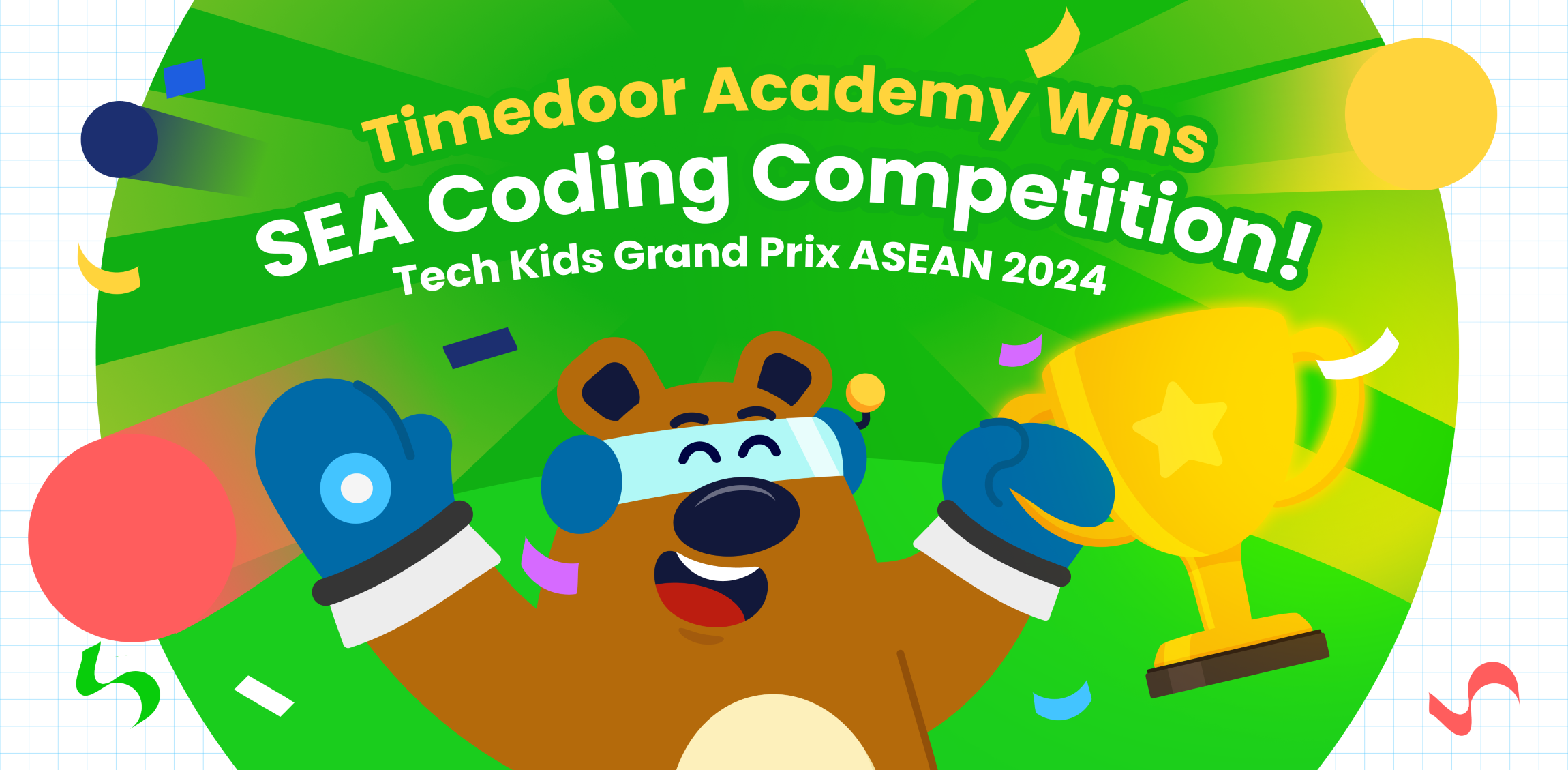
Timedoor Academy Win Coding Competition in Southeast Asia! image

Timedoor Academy Shines at the Biggest Kids Coding Competition in Southeast Asia!

We are thrilled to share the outstanding achievements of our students at the largest kids coding competition in Southeast Asia, Tech Kids Grand Prix ASEAN 2024, organized by a prominent Japanese company. This prestigious event brought together young coding enthusiasts from various countries, providing them with an incredible platform to showcase their creativity, skill, and determination.

An Unforgettable Event

This competition provided a platform for kids to showcase their unique coding projects, ranging from mobile apps to games, and even multimedia presentations. More than just a competition, it was an opportunity for students to explore their passions, push their boundaries, and connect with like-minded peers.

Timedoor Academy is thrilled to announce that three of our students stood out in the competition, earning impressive awards for their innovative work. Timedoor Academy also had several other students who earned Top 30 recognition, which further demonstrates the exceptional talent and dedication within our community.

Nadzkara Fakhri Madenda (Fay)

Fay menciptakan sebuah game interaktif kekayaan budaya Indonesia. Proyek ini memperkenalkan berbagai aspek budaya, seperti makanan tradisional, alat musik, pakaian, dan permainan rakyat daerah Indonesia. Fay meraih Presentation Award berkat kemampuannya dalam mempresentasikan proyek ini secara menarik dan detail di depan para juri.

Mohammad Fardeen

Fardeen dari Bangladesh, menciptakan sebuah aplikasi tabungan yang ditujukan untuk anak-anak. Fardeen terinspirasi dan merancang platform yang membantu anak-anak memahami pentingnya menabung dan literasi keuangan. Berkat visinya yang inovatif dan relevan, Fardeen berhasil meraih Product Award.

Top 30 Achievers

In addition to our winners, we also want to acknowledge the Top 30 students who represented Timedoor Academy with excellence. These students achieved impressive rankings that reflect their hard work and commitment:

  • I Nyoman Aditya Basudeva Mahaputra (Gatsu Branch)
  • Gede Agasthya Putra Darmawan (Gatsu Branch)
  • Theodorus Giovanni D (Gayungan Branch)
  • Jabir Sharwar (Online Bangladesh)
  • Mahrus Rahman Ayan (Online Bangladesh)

We are incredibly proud of all these students for their exceptional achievements and their contributions to the competition.

A Truly Memorable Experience

For our winners, this competition was more than just about winning—it was about growth, learning, and gaining invaluable experience. Both Fay and Fardeen expressed how meaningful the competition was to them, highlighting how much they learned throughout the process and how grateful they were for the guidance and support from Timedoor Academy and their dedicated teachers. Fay and Fardeen described the experience as “awesome” and said it was a journey they would always cherish.

Support from Timedoor Academy

To cheer on our students, Yutaka Tokunaga (CEO), Ayu Krisnasari (Curriculum Manager), and Bernadet Andini (Curriculum and Teacher Leader) flew to Singapore to provide their support during the event. Their presence was a testament to Timedoor Academy’s commitment to empowering students and supporting their growth at every stage of their learning journey.

We are incredibly proud of all the students who participated in this prestigious event. Their success is a reflection of their creativity, perseverance, and the dedication of the teachers and mentors who supported them. This competition has shown that Timedoor Academy students are truly capable of achieving greatness.

Looking Ahead

As we celebrate these incredible achievements, we are also looking forward to future opportunities for our students to shine. Timedoor Academy will continue to support and nurture young talent, helping them develop the skills they need to succeed in the digital world. We are excited to see what our students will accomplish next!

Stay tuned for more inspiring stories from Timedoor Academy as we continue to empower the next generation of innovators!

We provide opportunities for children to explore their potential in the programming world through our free trial sessions.

For more information, please visit the link here.
Keep Reading

<strong>Building Positive Habits in Children on National Children’s Day</strong>
Building Positive Habits in Children on National Children’s Day
Every year on July 23rd, Indonesia celebrates National Children’s Day to show appreciation for the next generation. It is a moment of reflection for parents, educators, and communities to prioritize the needs, safety, and development of children. One of the most impactful ways to invest in a child’s future is by building positive habits in children from an early age. Habits are behaviors formed through repetition, and they often last a lifetime. Childhood is a critical phase in which values and patterns take root. That is why building positive habits in children during these formative years is so important. Why Early Habits Matter Simple routines like tidying up toys, saying “thank you,” or putting trash in the bin may seem minor. However, they lay the foundation for greater life skills such as responsibility, discipline, and empathy. On a broader level, building positive habits in children involves nurturing a mindset of honesty, teamwork, curiosity, and respect for learning. Children who are raised with consistent, positive habits are more likely to grow into responsible, independent individuals with strong character. On the other hand, children who lack structure or guidance during their early years may adopt unhealthy behaviors that are difficult to change later. The Role of Parents and the Environment Parents play the central role in building positive habits in children. Kids learn more from what they see than from what they are told. That means parents must model the values they wish to pass on. Showing punctuality, gratitude, patience, and balanced screen time will speak louder than any instruction. Beyond the home, children are shaped by their surroundings schools, peers, and community influences all matter. A supportive environment with positive reinforcement, teamwork, and structured activities helps strengthen the values instilled at home. Practical Ways to Start Building Positive Habits in Children Be Consistent Change doesn’t happen overnight. Whether it’s encouraging your child to read each night or tidy up after playing, repetition is key. Even ten minutes of daily practice can make a long-term difference. Lead by Example Children mimic behavior. If you want your child to manage time well, show them how you do it. Let them see you following schedules, keeping promises, and avoiding distractions. Use Encouragement and Praise A simple “Great job!” or “Thank you for helping” goes a long way. Positive reinforcement helps motivate kids to repeat good behaviors. Allow Room for Mistakes When building positive habits in children, understand that mistakes are part of the learning process. Patience and guidance are more effective than punishment. Involve Children in Decision-Making Let your child help plan their daily routine or choose their afternoon activity. When they feel a sense of ownership, they are more likely to stick to their responsibilities. Integrate Technology Wisely In today’s world, technology cannot be separated from childhood. Instead of avoiding it, guide your child to use it for learning. Educational apps, coding platforms, and creative tools can help turn screen time into productive time. National Children’s Day as a Moment for Reflection and Action National Children’s Day is not just a celebration, but an opportunity for reflection. As a society, have we done enough to support and protect children? As parents, have we been present enough in guiding their development? And most importantly, are we truly committed to building positive habits in children that will prepare them for the future? Positive habits are not built in a day. They take consistency, collaboration, and encouragement. Families, schools, and communities must work hand in hand to create environments that nurture growth and character. Try a Free Coding Class at Timedoor Academy The journey of parenting is filled with joy, challenge, and responsibility. National Children’s Day reminds us that every child deserves support, attention, and guidance. And one of the most meaningful forms of guidance we can offer is by consistently building positive habits in children. At Timedoor Academy, we believe that technology and character education go hand in hand. Our online coding and digital literacy programs are designed not only to build skills, but also to nurture self-discipline, curiosity, and confidence. Register your child for a free trial class today and take the first step in building habits that last a lifetime. Let’s shape a brighter future together one child at a time.
How Virtual Reality in Kids Education Changes Learning
As technology becomes more embedded in daily life, education continues to evolve alongside it. One of the most exciting developments is the use of virtual reality in kids education, a concept that is no longer just futuristic. From classrooms to living rooms, VR is now used to enhance how children explore, understand, and retain knowledge. This article explores how VR is transforming the way kids learn, its benefits, real-world applications, and how parents and schools can embrace this shift.   What Is Virtual Reality in an Educational Context? Virtual reality is a digital simulation that allows users to interact with a 3D environment. In educational settings, it means that students can immerse themselves in topics such as history, science, art, and space in ways that were never possible before. Instead of reading about ancient civilizations, children can walk through virtual ruins. Rather than imagining the solar system, they can experience it in full scale. This hands-on approach to learning is what makes virtual reality in kids education so impactful.   From Passive Learning to Immersive Exploration Traditional learning often relies on reading, note-taking, and static visuals. While these methods are effective, they are not always engaging for every type of learner. Virtual reality enables multisensory learning experiences that feel more like exploration than instruction. For example, a child learning about volcanoes can virtually step inside one to see lava flow and tectonic plate movement. This type of experiential learning boosts curiosity and helps children grasp abstract or complex topics much faster.   Key Benefits of Virtual Reality in Kids Education 1. Increased Engagement and Motivation VR transforms lessons into adventures. Children are naturally more engaged when learning feels like play. This makes it easier to hold their attention and deepen their focus on the subject matter. 2. Better Knowledge Retention When children interact with content instead of simply reading or listening, their brains form stronger memory connections. VR helps students retain information through direct experience, not just memorization. 3. Safe Exploration of Real-World Concepts Certain experiments or field trips may be too dangerous, expensive, or inaccessible in real life. Virtual reality allows students to simulate these experiences safely. From exploring deep ocean ecosystems to observing chemical reactions, VR enables safe and repeatable learning. 4. Encourages Independent Learning Virtual reality in kids education supports autonomy. Children can learn at their own pace, repeat difficult lessons, and explore topics that interest them deeply. This fosters independent thinking and self-directed learning. 5. Inclusion for Different Learning Styles Some children learn visually, others through movement or sound. VR incorporates multiple modes of learning, helping educators reach students who might otherwise struggle with standard teaching formats.   Examples of VR Use in Real Classrooms Many educational institutions and platforms are already applying virtual reality in kids education. Some noteworthy tools include: Google Expeditions: Offers virtual field trips to locations such as the Great Wall of China or the surface of Mars. VictoryXR: Creates full science labs and virtual classrooms where students can conduct experiments. ClassVR: Provides ready-made curriculum-aligned content for schools to use with their students. These examples demonstrate how virtual reality in kids education is already improving outcomes in subjects like science, history, and geography.   How Parents and Teachers Can Get Started Adopting VR technology for learning doesn’t have to be expensive or difficult. Many educational VR platforms are compatible with smartphones and entry-level headsets. Parents can start by: Downloading trusted educational VR apps Using cardboard VR viewers with supported apps Setting screen time guidelines and offering support during learning sessions Teachers can integrate VR into their lesson plans by using tools that align with existing curriculum. It is important to ensure that content is age-appropriate and has clear learning objectives.   Things to Consider While the benefits are clear, there are a few considerations before adopting VR for children’s learning: Supervision: Younger kids need adult guidance to navigate VR content safely. Screen Time: Use VR as a supplement, not a replacement for human interaction or physical play. Content Quality: Not all VR apps are educational. Review each platform and select those developed by educators or trusted publishers. Equipment Requirements: Make sure devices are compatible and safe for children’s use. With thoughtful implementation, virtual reality in kids education can be a highly positive tool for both home and school environments.   The Future of Learning Is Immersive In 2025, virtual reality in kids education is no longer a novelty. It is becoming a core part of how children learn new skills, discover the world, and stay engaged in school. The technology is helping transform learning from something passive into something active, memorable, and exciting. As the cost of VR continues to decrease and content improves, more families and schools will be able to offer students this immersive learning experience.   Support Your Child’s Learning Journey with Timedoor Academy Looking for an engaging and tech-friendly way to support your child’s education? Timedoor Academy offers interactive online courses in coding, robotics, math, and digital creativity. While not all our classes use VR, they are designed with innovation and child engagement at the core. Sign up for a free trial class today and see how your child can build future-ready skills in a fun and structured environment — all from the comfort of home.
9 Parenting Tips for Children That Help Shape Their Future
Being a parent is more than just meeting your child’s physical needs. It is a lifelong responsibility to nurture their character, emotional well-being, and future readiness. In today’s fast-paced and digital world, parenting requires a more adaptive and thoughtful approach. That is why understanding effective parenting tips for children is crucial to providing meaningful support. 1. Understand Your Child’s Personality Every child is unique. Some are highly active and outgoing, while others may be quiet and reserved. Getting to know your child’s personality helps you adjust your communication style and parenting strategy. One of the most important parenting tips for children is observing without judgment and giving your child the space to express themselves freely. 2. Build Open Communication Communication is the foundation of a strong parent-child relationship. Children who feel heard and respected tend to develop greater self-confidence. Simple daily moments, like meals or car rides, can be perfect for building open and honest conversations. One of the essential parenting tips for children is to listen actively, avoid harsh judgment, and respond with empathy. 3. Set Clear and Consistent Boundaries While freedom is important, children also need boundaries to feel secure and learn responsibility. Parents who consistently apply clear rules help children develop a sense of discipline. Within the framework of parenting tips for children, boundaries are not meant to control but to guide healthy behavior and build self-regulation. 4. Be a Role Model Children learn more from what they see than what they are told. If you want your child to be respectful, honest, and responsible, you need to model those behaviors yourself. One of the most powerful yet often overlooked parenting tips for children is leading by example through everyday actions. 5. Guide Technology Use with Care Children today are exposed to technology from a very early age. Instead of banning gadgets, parents should guide their use wisely. Introduce children to educational apps and creative digital tools that encourage productive learning. Among modern parenting tips for children, teaching digital responsibility is crucial. 6. Offer Emotional Support Children who feel emotionally supported are more resilient and confident. Be there for your child during difficult moments, celebrate their achievements, and show them unconditional love. Emotional support is one of the most valuable parenting tips for children, as it fosters inner strength and emotional intelligence. 7. Create Healthy Daily Routines Consistent routines for sleeping, eating, studying, and playing give children a sense of structure and security. These routines also help develop time management skills. Simple, repeated habits are a vital part of effective parenting tips for children, laying a solid foundation for future growth. 8. Involve Children in Decision-Making Give your child opportunities to participate in everyday decisions, such as choosing their clothes or planning family meals. This empowers them to think critically and express their preferences. From a list of practical parenting tips for children, allowing children to make choices builds independence and self-esteem. 9. Keep Learning as a Parent No parent is perfect, and every child is different. Staying open to learning helps you adapt to your child’s changing needs. Attending parenting workshops, reading educational books, or seeking professional advice can strengthen your parenting skills. Among all parenting tips for children, the willingness to grow with your child may be the most important. Shaping the Future Begins at Home Parenting is a long-term investment filled with joys and challenges. By applying proven parenting tips for children, we create a supportive environment that allows our children to thrive emotionally, socially, and intellectually. Small actions today can build the future we dream of for our kids. If you’re looking to enhance your child’s learning journey, Timedoor Academy offers an engaging platform where children can explore the world of technology in a safe, structured, and exciting way. Sign your child up for a free trial at Timedoor Academy today and see how fun, guided tech learning can boost their confidence, creativity, and future readiness.
float button